South and Central Asia Subcommittee Chairman Huizenga Delivers Opening Remarks at Hearing on The U.S. India Strategic Partnership
WASHINGTON, D.C. – Today, House Foreign Affairs South and Central Asia Subcommittee Chairman Bill Huizenga delivered opening remarks at a subcommittee hearing titled "The U.S. India Strategic Partnership: Securing a Free and Open Indo-Pacific".
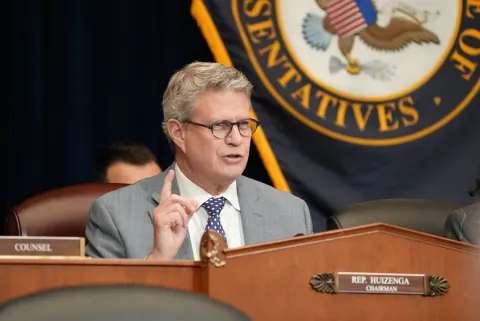
The US-India relationship is no longer just important. It is a defining relationship of the 21st century. If America wants a free Indo-Pacific resilient supply chains and a world where democracy, not authoritarianism, sets the rules, then our partnership with India is critical. While the partnership has been nuanced since India gained Independence in 1947, and India's nonalignment posture shaped its strategic identity, the United States and the Republic of India share a common vision of a free, open and secure Indo-Pacific rooted in democratic values and a deep desire for freedom.
That's why every American administration, Republican and Democrat, has strengthened ties, or certainly at least attempted to, making clear that the United States does not see India as a temporary or transactional partner. Still, we must view this moment with clear eyes. President Putin's warm visit to India last week and India's participation in China's, Shanghai cooperation organization summit this September raised some understandable concerns.
At the same time, India has agreed to purchase more American energy, thereby significantly reducing its reliance on Russia. In fact, on my way in earlier, I ran into a delegation of parliamentarians from Latvia, who, through connections with Michigan and the Michigan National Guard and the Latvian military, we're all very acquainted with them. And, when I mentioned that I was going to be chairing this hearing on India and US relations, the first thing that they brought up was to please ask them to stop buying Russian oil so that they don't have the cash to be a threat to us. So, message received, message delivered.
Moreover, authoritarian powers like China and Russia are redrawing borders by force, undermining democratic norms and coercing their neighbors. Nowhere is this more evident than in the Indo-Pacific, where an increasingly aggressive China threatens regional stability, global prosperity and the open flow of commerce. China's string of pearls ideology is no longer just a theory, but rather an overt attempt to encircle and control the Indian ocean, its sea lanes, and expand the militarization of these strategic ports and trade routes. We cannot allow this to happen. India knows these risks firsthand.
Since 2020, Chinese forces have killed Indian soldiers on their shared border. India has responded decisively, pushing back against Chinese military pressure and limiting China's influence inside India and in neighboring Bhutan. Today, US-India cooperation spans defense, technology, counterterrorism and trade.
Defense ties have never been stronger. India participates in the quad along with our allies Japan and Australia. Additionally, our militaries conduct joint exercises from the Indian ocean to Rajasthan and transfer some of our most advanced defense technologies to deepen military to military trust and interoperability. The counterterrorism cooperation is equally significant.
The LET and TRF, the organizations responsible for the heinous attack in, Pahalgam were designated by the Trump administration as foreign terrorist organizations in July of 2025, reflecting our shared commitment to fighting terror wherever it occurs. This partnership is not only about security. People to People ties between our nations are extraordinary. More than 5 million Indian Americans contribute to the American economy. They serve in our military. They lead major companies. Meanwhile, American students, businesses, and tourists engage with India every year, strengthening our connection to one of the world's most vibrant democracies. In fact, I'm submitting a letter for the record from the Indo-American chamber of commerce, headquartered in Detroit, Michigan, supporting the work of this hearing and stressing that the US-India relationship is not just a diplomatic one, but rather a living bridge of shared values, democratic principles, and economic opportunity, without any objection.
India is one of the fastest growing major economies in the world. American companies increasingly see India not just as a market but as a partner to innovation, especially in AI, communications, and advanced technologies, where collaboration already exists. American companies are eager to enter the Indian market on a level playing field. A new trade deal with India under President Trump and Prime Minister Modi would further realize this goal and enhance the relationship. Open markets, strengthening supply chains and driving innovation, all of which would chart a new beginning in our storied partnership. I look forward to hearing from our witnesses and, on how the world's largest economy and the soon to be third largest economy can work together to counterbalance China and preserve a free and open Indo-Pacific.
###