Rep. Young Kim Delivers Opening Remarks at Full Committee Hearing on Advancing National Security through Commercial Diplomacy
February 24, 2026
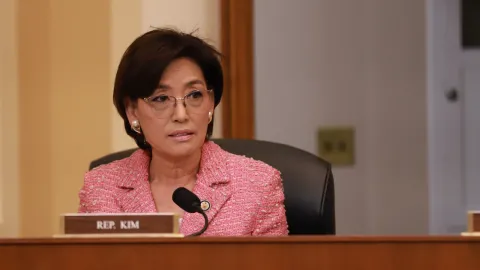
WASHINGTON, D.C. – Today, House Foreign Affairs East Asia and Pacific Subcommittee Chairwoman Young Kim delivered opening remarks at a full committee hearing titled "Advancing National Security through Commercial Diplomacy".
Image
-Remarks-
This hearing focuses on commercial diplomacy, which the President's national security strategy puts at the tip of the spear of our foreign policy. We will hear how the State Department, through the leadership of the undersecretary of economic affairs, deploys the bureaus and offices of economic statecraft to support American businesses abroad, protect American industry at home, and advance our national security interests. For too long, we assumed that global markets would naturally align with U.S. interests. That assumption has proven false. Our adversaries have weaponized trade, investment, supply chains, and technology to undermine American industrial capacity and expand their influence. As the President has said repeatedly, economic security is national security. Whether we are talking about enforcing sanctions, securing critical minerals, supply chains, building new semiconductor manufacturing capacity, expanding energy exports or strengthening transportation networks, these priorities are about protecting America, American workers, businesses, and our strategic position in the world. Under President Trump's leadership, US foreign policy is guided by a clear principle: American strength, commercial, industrial, technological is the foundation of American diplomacy abroad.
Today, economic policy is not separate from foreign policy. It is at the heart of it. Last year, this committee led a State Department authorization process to evaluate reforms, ensuring the department has the expertise, the structure and leadership that is necessary to execute that agenda effectively. Many of those provisions are now law. We will continue pursuing additional reforms, especially those that empower the bureaus and offices under Mr. Helberg's purview. Any reform must meet a simple test. Does it make the United States stronger, safer, more prosperous? The State Department, and particularly the so-called E family, plays a critical role in this effort. Its global diplomatic footprint provides leverage no other agency possesses. As we continue our oversight, the committee will examine whether returning the U.S. Foreign Commercial Service to the State Department and strengthen our commercial diplomacy regime, reinvigorate a neglected FCS, sharpen accountability, and better align economic tools with foreign policy objectives.
That influence must be matched with clear priorities and measurable accountability. Since assuming his role last fall Under Secretary Jacob Helberg has emphasized supply chain security, allied coordination and competition, and critical and emerging technologies as core priorities. Earlier this month, he helped convene the 2026 critical minerals ministerial, bringing together 54 nations to advance more secure and diversified supply chains. His Pax Silica initiative focused on securing the full stack from energy and critical minerals to advance manufacturing and next generation technologies, reflects the type of integrated economic strategy this committee expects to see from the department. As Congress, we have a responsibility to ensure these initiatives endure beyond any single administration.
That is why I, alongside with my ranking member, Ami Bera and Chairman Brian Mast, we introduced the bipartisan dominance act to make the United States the partner of choice for countries seeking secure, diversified and resilient critical mineral supply chains. Breaking China's chokehold on critical minerals will not happen overnight. It will require sustained bipartisan resolve here in Congress and in close coordination with the administration.
So I look forward to working with you, Mr. Helberg, to ensure that your efforts represent not just the progress, but decisive step forward, ending China's control over the strategic supply chains. Let me be clear. American economic strength is the foundation of the American leadership abroad. Diplomacy should reinforce U.S. competitiveness and support American workers and businesses, and strengthen our long term industrial and technological base. The department must be empowered to engage and negotiate from a position of strength. That means standing up to unfair economic practices, enforcing the rules, supporting U.S. energy and exports, and ensuring that American economic power is used deliberately and strategically. We need to ensure our foreign policy institutions are aligned with the realities of the global competition. I thank Undersecretary Helberg for joining us today, and we look forward to discussing how economic statecraft is being implemented and what Congress can do to ensure it delivers true results to the American people.
That is why I, alongside with my ranking member, Ami Bera and Chairman Brian Mast, we introduced the bipartisan dominance act to make the United States the partner of choice for countries seeking secure, diversified and resilient critical mineral supply chains. Breaking China's chokehold on critical minerals will not happen overnight. It will require sustained bipartisan resolve here in Congress and in close coordination with the administration.
So I look forward to working with you, Mr. Helberg, to ensure that your efforts represent not just the progress, but decisive step forward, ending China's control over the strategic supply chains. Let me be clear. American economic strength is the foundation of the American leadership abroad. Diplomacy should reinforce U.S. competitiveness and support American workers and businesses, and strengthen our long term industrial and technological base. The department must be empowered to engage and negotiate from a position of strength. That means standing up to unfair economic practices, enforcing the rules, supporting U.S. energy and exports, and ensuring that American economic power is used deliberately and strategically. We need to ensure our foreign policy institutions are aligned with the realities of the global competition. I thank Undersecretary Helberg for joining us today, and we look forward to discussing how economic statecraft is being implemented and what Congress can do to ensure it delivers true results to the American people.
###