Oversight and Intelligence Subcommittee Chairman Cory Mills Delivers Opening Remarks at Hearing on Waste, Fraud, and Abuse in Foreign Assistance
WASHINGTON, D.C. – Today, House Foreign Affairs Oversight and Intelligence Subcommittee Chairman Cory Mills delivered opening remarks at a subcommittee hearing titled, "Waste, Fraud, and Abuse in Foreign Assistance: Lessons Learned and Charting a Path Forward"
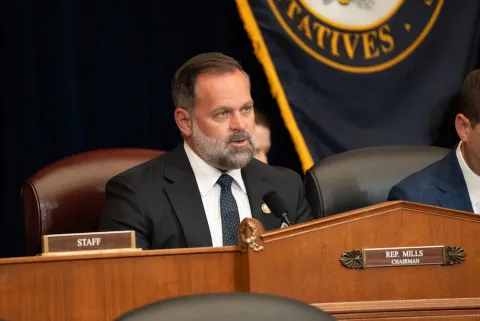
-Remarks-
I'd like to thank our distinguished witnesses for appearing before the subcommittee today, and for supporting our efforts to safeguard U.S. taxpayer dollars to expose waste, fraud and abuse, and hold accountable those who have been exploiting U.S. generosity. As a nation, we should be embarrassed that funding for foreign assistance has too often strengthened America's adversaries – the same adversaries who have oppressed and terrorized the populations we sought to help.
Whether through a local NGO, a large for-profit entity, or a public international organization, opportunistic bad actors have for years exploited pervasive weaknesses in the system of foreign assistance that we created. From my own time in Afghanistan, I witnessed firsthand how contracts profited enormously, with little to show for it.
Between 2005 and 2017, $259 million was spent on a road project that was never even completed. After 12 years, only about 15% of the road was built, and even those sections that were completed quickly deteriorated. Contractors benefited from lack of oversight and took U.S. taxpayer dollars without completing the projects. In 2025, the special inspector general for Afghanistan reconstruction, SIGAR, estimated that as little as 30 to 40% of donor funds actually reach the intended population after the Taliban's and other fees, bribes and extortion. Terrorists have extorted and enriched themselves through international aid around the world. For years, Al-Shabab, a designated terrorist organization, extorted millions of dollars annually through collecting taxes, establishing roadblocks to UN aid. In the early 1990s, Somalian warlords deliberately starved their own people to encourage international aid and in line, basically buy their own pockets. For decades, inspector generals and auditors have sounded the alarm to systemic oversight and accountability failures that have enabled waste, fraud and abuse in foreign assistance.
From the lack of internal controls in the early stages of awarding a grant or contract, to the opaque layers of subcontracting that follows, the bad actors at every single level have profited from U.S. foreign assistance. In June of last year, a contracting officer for the United States Agency for International Development, USAID, received an estimated $1 million in bribes to repeatedly manipulate the procurement process, approve awards and deceive USA decision makers in favor of two awardees. Three owners and Presidents of their respective companies also pleaded guilty for a decade-long bribery and fraud scheme that involved over $550 million in prime contracts.
Last year, the President took a very important step to end these wasteful and corrupted practices. With USAID’s failures now behind us, we have an opportunity to chart a new path forward, a path that safeguards U.S. funds and that does not enrich our enemies. A path that does not measure effectiveness by dollars spent, but by real outcome that doesn't just benefit the intended recipients, but also clearly makes the United States safer, stronger, and more prosperous. Reforming foreign assistance has been long overdue. And with that, I look forward to hearing how we can chart this new path together.
###