Middle East and North Africa Subcommittee Chairman Lawler Delivers Opening Remarks at Hearing on Restoring Mission Focus at the State Department
WASHINGTON, D.C. – Today, House Foreign Affairs Middle East and North Africa Subcommittee Chairman Mike Lawler delivered opening remarks at a full committee hearing titled "Restoring Mission Focus at the State Department: Authority, Accountability, and the Role of the Foreign Service".
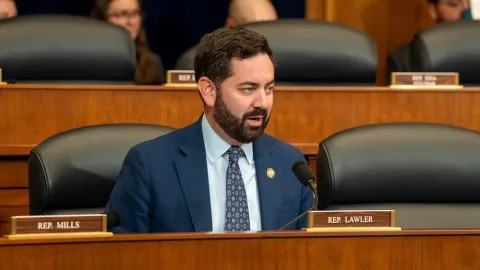
-Remarks-
We are here today to discuss one of the most vital components of American foreign policy and national security. Our foreign service officers, FSO’s, work for the State Department in U.S. missions. They focus on the consular, economic, public diplomacy, management and political policies and operations abroad. We call on them day in and day out to represent our values and put diplomacy into action throughout the world. Foreign service officers frequently serve in some of the most challenging environments in the world. Today, many are posted across the Middle East, working around the clock to assist with the evacuation and protection of American citizens in a rapidly evolving security environment. Others serve in adversarial countries or strategic competitors that are not always friendly to U.S. interests like China. And some are stationed in high threat environments, such as in Iraq or Sudan, often serving separated from their families.
Even in these conditions, FSO’s must carry out their mission, advancing U.S. interests and helping to keep our nation safe. There is no room for failure here, and yet the foreign service act, which shapes how FSO’s are trained and how they work, has largely remained untouched for the last four-and-a-half decades. That changes now, and it starts with a comprehensive look at the mission intent of the foreign service.
Today we will ask a basic but critical question: what is diplomacy and how has the role of foreign service officers changed since the FSA was last reviewed over 45 years ago?
Last year, this committee passed meaningful State Department reforms to reauthorize and codify critical components of our national security apparatus. There, we focused on command and control in the department and its structure. Today, our hearing builds on that legislation as we turn our attention to the State Department's culture, its diplomatic missions abroad and how the Foreign Service Act should be adjusted to fit a world that has certainly changed since 1980.
We are taking a deep dive into the existing authorizing authorities over FSO’s so Congress can provide them with more direction to promote American interests and national security in their missions. The FSA established the modern foreign service, providing the State Department with the direction and protection to promote American interests and national security through our diplomats. Key components of this law describe the main functions, responsibilities, and purpose of the foreign service. They also direct the administration processes of the foreign service examinations and promotions. Further, the Foreign Service Act provides the FSO professional development programs and support. These are only a few of the many provisions that make our diplomatic corps what it is today.
It is the responsibility of this committee to ensure that these authorities equip FSO’s with the tools and training to represent a cohesive stance in promoting national security interests across the globe. The United States has nearly 280 posts across the world, with almost 14,500 FSO’s employed. At each post, the foreign service and our FSO’s are the face, voice, and representatives of America. The training and systems in place for our FSO’s should reflect that monumental task. It is critical that the service and our FSO’s are united in a clear mission and rooted in a culture that effectively supports the needs of U.S. foreign policy in this decade.
###