Chairman Mast, HFAC, Advances MATCH Act
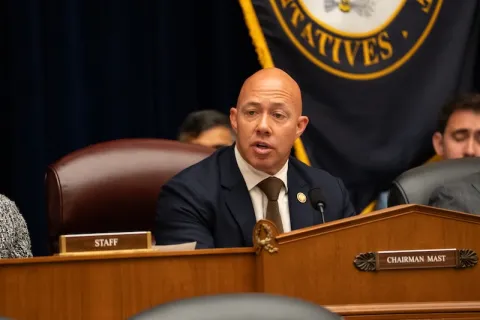
WASHINGTON, D.C. – Today, the House Foreign Affairs Committee advanced the Multilateral Alignment of Technology Controls on Hardware (MATCH) Act as part of a markup of a series of export control measures aimed at ensuring America continues to lead in the AI Arms Race.
“This bill would address one of the gravest issues we face today, by limiting China’s access to the most critical machines and parts needed to make advanced chips,” House Foreign Affairs Committee Chairman Brian Mast said. “Without these tools, China can’t make their own chips, and they likely won’t be able to for years to come.”
China’s production of advanced AI chips depends on U.S. and allied technology. The MATCH Act, introduced by Rep. Baumgartner would close loopholes to prevent the Chinese military from accessing advanced semiconductors.
It requires the Secretaries of Commerce and State to review the chokepoint controls that the United States and its allies should control for China, and review which facilities in China conduct advanced manufacturing of semiconductors.
“China has made it abundantly clear that it intends to dominate the technologies that underpin both our economy and our national defense. The United States cannot afford to leave open back doors that allow the Chinese Communist Party to acquire the tools it needs to leap ahead in semiconductor manufacturing. I introduced the MATCH Act to ensure that America and our allies move in lockstep to close these gaps, defend our technological edge, and safeguard the supply chains that power everything from our weapons systems to our critical infrastructure. This is about protecting American workers, American innovation, and American security for the long haul.” said Rep. Michael Baumgartner.
The measure was among 15 GOP-led bills focused on ensuring our export controls protect American technology from falling into the hands of our adversaries. The proceeding marked the largest significant export control markup in the history of Congress.
In addition to the MATCH Act, the committee advanced:
H.R. 8202, To amend the Export Control Reform Act of 2018 to provide for a ten-year statute of limitations for export control violations.
H.R. 7962, To amend the Export Control Reform Act of 2018 relating to the review of the interagency dispute resolution process.
H.R. 8169, To amend the Export Control Reform Act of 2018 to provide for expedited consideration of proposals for additions to, removals from, or other modifications with respect to entities on the Entity List, and for other purposes.
H.R. 4505, To strengthen enforcement of United States export controls by increasing the number of export control officers of the Bureau of Industry and Security of the Department of Commerce who are stationed in foreign regions.
H.R. 7003, To authorize the Under Secretary of Commerce for Industry and Security to appoint certain personnel in order to attract highly qualified experts, and for other purposes.
H.R. 5853, To amend the Export Control Reform Act of 2018 to increase the civil penalties that may be imposed under such Act.
H.R. 8288, To amend the Export Control Reform Act of 2018 to provide assistance for compliance with that Act.
H.R. 6331, To modify certain definitions under the Export Control Reform Act of 2018.
H.R. 8285, To amend the Export Control Reform Act of 2018 to require a competitive market review of applications for a license to export, reexport, or transfer in-country certain technology, and for other purposes.
H.R. 4920, To require modernization of information technology systems and applications of the Bureau of Industry and Security of the Department of Commerce.
H.R. 6624, To restrict the export to foreign entities of concern of United States intellectual property and sensitive information related to synthetic biology, and for other purposes.
H.R. 6996, To facilitate the export of United States artificial intelligence systems, computing hardware, and standards globally.
H.R. 5543, To require the Secretary of State, in coordination with the Secretary of Defense, to submit a report on emerging threats posed to the Republics of Estonia, Latvia, and Lithuania, and for other purposes.
H.R. 6058, To provide for multilateral semiconductor technology supply chain coordination, and for other purposes.
H.R. 8320, To require additional duties of the Ambassador at Large for Cyberspace and Digital Policy with respect to United States diplomatic efforts ahead of certain international conferences, and for other purposes.
H.R. 6322, To amend the Export Control Reform Act of 2018 to establish a whistleblower incentive program and provide protections to whistleblowers.
H.R. 8283, To prevent foreign adversaries from threatening the national security of the United States by extracting key technical features of closed-source, American-owned artificial intelligence models, and for other purposes.
H.R. 8284, To enhance the administration of export control licenses under the Export Control Reform Act of 2018, and other purposes.
H.R. 8287, To require the Assistant Secretary of State for Intelligence and Research to submit a comprehensive report on the impact and effectiveness of United States semiconductor export controls on the People’s Republic of China, and for other purposes.
H.R. 8036, To amend the Export Control Reform Act of 2018 to permit the Secretary of State, Defense, or Energy to submit proposed rules to the Export Administration Review Board, to require the Secretary of State to evaluate the military civil fusion strategy of the People’s Republic of China, and for other purposes.
H.R. 8289, To amend the Export Control Reform Act of 2018 to ensure expeditious processing of license applications, and for other purposes.
###