Chairman Mast, HFAC, Advances Chip Security Act
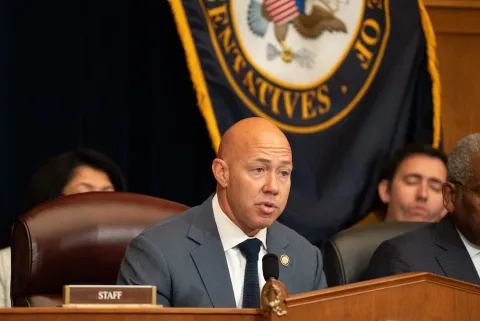
WASHINGTON, D.C. – Today, the House Foreign Affairs Committee advanced the Chip Security Act, a measure to prevent the illicit smuggling of advanced AI chips to foreign adversaries as part of a full committee markup.
“If we're going to export advanced AI chips, we need confidence that they don’t end up in the hands of the Chinese military. We’re continuously seeing examples of Chinese espionage, theft, and diversion over and over again. We can’t allow this to keep happening,” said House Foreign Affairs Committee Chairman Brian Mast. “This is about winning the AI Arms Race. We are seeing how advanced AI chips drive everything taking place on the battlefields in Iran, Russia, and Ukraine. They also shape decision-making around how nuclear weapons are used—who strikes first, who strikes last, whose AI can improve faster, and whose can’t. For us to give China any capability, inroad, or advantage in this is nonsensical.”
“The Chip Security Act enhances protections on AI chip exports by scaling up best security practices and encouraging innovative technologies,” said South and Central Asia Subcommittee Chairman Bill Huizenga. “This bill directly supports the Trump administration’s AI Action Plan recommendations and benefits from both the administration’s technical assistance and industry feedback.”
“America has the best semiconductors in the world, and we must defend our advantage over China, which is actively working to break the law and smuggle American chips. The Chip Security Act will make it harder to steal from us and protect American jobs and industry. This legislation also advances President Trump’s AI Action Plan by implementing location verification and denying our adversaries access to computing power. Thank you to Chairman Mast, Congressman Huizenga, and the House Foreign Affairs Committee for advancing this legislation,” said Select Committee on China Chairman John Moolenaar.
The Chip Security Act, introduced by Rep. Huizenga, underscores the importance of U.S. leadership in AI in achieving the foreign policy and national security objectives of the United States and its allies.
It requires the Department of Commerce to establish chip security mechanisms for advanced chips we export abroad, helping the U.S. ensure our most sensitive technology goes where it’s supposed to.
In addition to the Chip Security Act, the committee advanced several measures including:
H.R. 7654, To authorize the consolidation of reports required to be submitted by the Bureau of Global Health Security and Diplomacy of the Department of State, and for other purposes.
H.R. 7642, To authorize the recruitment and retention of specialized disaster assistance professionals by the Department of State.
H.R. 7641, To provide for a pilot program to require congressional notification of additional information for certain foreign assistance programs.
H.R. 7633, To require the United States flag to be displayed on United States foreign assistance.
H.Res. 971, Condemning the coercive actions of the People’s Republic of China against Japan in response to statements regarding Taiwan and reaffirming the United States commitment to its allies in the Indo-Pacific region.
H.R. 1744, To extend and authorize annual appropriations for the United States Commission on International Religious Freedom through fiscal year 2028.
H.R. 3447, To require the Secretary of Commerce to issue standards with respect to chip security mechanisms for integrated circuit products, and for other purposes.
H.R. 7669, To require a report that describes the current restrictions imposed by the Taliban on women and girls in Afghanistan since August 2021.
H.R. 7058, To require the Secretary of State to conduct assessments of the risks posed to the United States by foreign adversaries who utilize generative artificial intelligence for malicious activities, and for other purposes.
H.R. 7653, To enhance diplomatic engagement on international biotechnology and biosecurity matters.
H.R. 6196, To authorize and encourage the United States to pursue a model of locally led development and humanitarian response and expand engagement with local actors and increase its local partner base.
H.R. 7632, To designate a Coordinator for hybrid warfare accountability, require the Secretary of State to submit a report identifying Chinese entities materially supporting Russia's defense industrial base and recommending appropriate sanctions, and for other purposes.
H.R. 2504, To require the Secretary of State to develop a strategy to strengthen United States-European nuclear energy cooperation and combat Russian malign influence in the nuclear energy sector in Europe.
H.R. 7649, To ensure that persons found responsible for the unauthorized diversion or destruction of United States humanitarian assistance are liable to the United States, and for other purposes.
H.R. 7630, To prohibit United States recognition of the claims of sovereignty of South Ossetia or Abkhazia within the Republic of Georgia.
H.R. 7675, Securing Partner Supply Chains Act
H.R. 7674, To require the Secretary of State to submit to Congress a strategy to support a democratic transition in Venezuela, and for other purposes.
H.R. 7605, To abolish the United States African Development Foundation.
H.R. 7616, To require the Secretary of State to develop a strategy to identify and mitigate relationships that pose a risk to United States foreign policy interests between certain European institutions and certain covered entities of concern, and for other purposes.
H.R. 6428, To require the Secretary of State to submit a report on participation in educational and cultural exchange programs.
###