Chairman Mast Delivers Opening Remarks at Hearing on Confronting Haiti's Terrorist Gangs
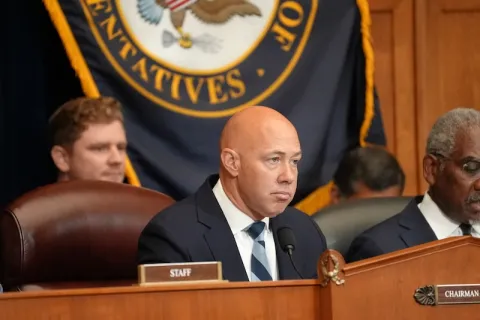
WASHINGTON, D.C. – Today, House Foreign Affairs Committee Chairman Brian Mast delivered opening remarks at a full committee hearing titled "Confronting Haiti’s Terrorist Gangs: The Gang Suppression Force and the Path Ahead.”
-Remarks-
Seven hundred miles from my home state of Florida, terrorist organizations control the Haiti national capital. They don't influence it, they control it. They hold an estimated 90% of Port-au-Prince. They have displaced more than 1.4 million. They murder, they kidnap, they rape, they castrate, they feed people what they castrate, they extort the Haitian people on a massive scale, they seek to replace the Haitian state with something that answers to them.
The consequences of a fully collapsed Haiti will not just stay in Haiti. It goes without saying that mass illegal immigration from a country explicitly governed as a safe haven for terrorists and traffickers would be harmful to America's interests and those of our allies.
Here's what makes this oversight hearing different. We have already run the experiment of getting this wrong. The previous administration's answer to stabilizing Haiti was the failed U.N. Multinational Security Support Mission, or the MSS, a program to bring in foreigners from places like Kenya and Chad to take on gangs while costing the American taxpayer over $1 billion in total, over $1 million per Kenyan that they sent into the country.
Don't take my word for that. The State Department told this committee that the mission was, “an ineffective boondoggle”. When the last Kenyan officers flew home this past April, Haiti's gangs controlled more territory than the day the mission began. That is the definition of failure. This is exactly why I advocated for not sending any contributions to the United Nations, because this is the kind of boondoggles that they run.
The United Nations authorized a mission that replaced it. The Gang Suppression Force is built differently and hopefully learns from the mistakes of the past. It is more kinetic force with a direct action mandate to unilaterally take the fight to the gangs. This is not just a police support mission, it's about eliminating terrorist gangs.
On paper, its costs are shared, assessed across the United Nations member states with an American share of about $117 million a year. That's far better than the over $1 billion that we spent in a year previously. I say on paper, because in practice, the American taxpayer is still underwriting this mission, and we will get to that.
These operations began June 1. As I said, I want this mission to succeed, but wanting and hope are not strategies. So today, this committee needs three things.
First, we need the mission's benchmarks for success. The mission's special representative owed the United Nations Security Council a strategy by July 1st. So today we need to find out are its benchmarks real or just aspirational? And what happens if some of them are missed?
Second, apart from our assessed contribution, the administration has rolled out bilateral assistance piece by piece, up to $40 million in bridge and sustainment funds, $68 million in equipment, a police recruitment surge, support for Haiti's armed forces, and now counterterrorism funds with no specific dollar figure attached. That money by the State Department's own accounting is going toward, among other things, buying meals ready to eat and bottled water. A bill that the department itself says belongs to those countries, not us. We were promised a force that learned the lessons of the MSS. But the US taxpayers, on top of the check we've already written, is still underwriting this mission's food and water. How much will this new GSF cost American citizens?
Third, we need honesty about what comes next in the significant challenges that remain. The U.N. mandate for the GSF expires on September 30th, before this force even reaches full strength. The first elections in a decade are scheduled for August, but Haiti's insecurity makes those unlikely. And a private company paid by Haiti, not by the American taxpayer, is putting the gangs on their heels, with no more than 150 people – Vectus Global, run by Erik Prince. Our own diplomats credit it with altering the momentum and the geometry of this fight, again with 150 individuals. If 150 contractors can do that, a 5,500 person U.N. force should have zero excuses, though that's all we received with the MSS mission.
To our witnesses. This committee is looking for candor. Tell us what is working. Tell us what is not. Tell us what you need. Helping Haiti is not impossible. But the lesson of the last mission was that failure was obvious for nearly two years, yet nobody changed course. That will not happen on this committee's watch.
###