Chairman Mast Delivers Opening Remarks at Hearing in U.S. Policy Challenges Post-Assad
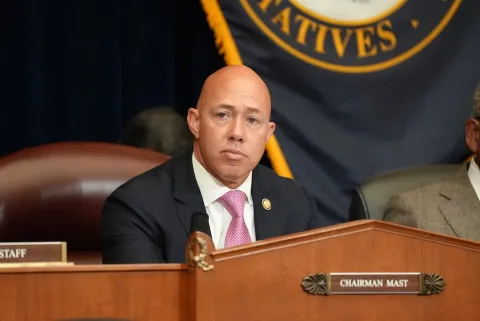
WASHINGTON, D.C. – Today, House Foreign Affairs Committee Chairman Brian Mast delivered opening remarks at a full committee hearing titled "Syria at a Crossroads: U.S. Policy Challenges Post-Assad".
- Remarks -
I think the United States of America, the world, and the Syrian people themselves are all hungry for Syria to turn the page from years of Syrian conflict and despot leaders to a country that adds to the region, adds to the world, instead of detracting from it.
A country that invites back in those who fled instead of creating more refugees. I don't believe that any of us thought transitions from the dictator Bashar al-Assad to now Syrian President Ahmed al-Sharaa would be without incident. But we've already seen too many incidents, in my opinion, too many incidents of security and violence against religious and ethnic minorities. There are a wide range of challenges faced in Syria in order to reach a peaceful, democratic governance. I can tell you that I had the opportunity to meet with the Syrian President. We spoke about a number of things. There are ongoing challenges, including the presence of foreign fighters within the security forces, many of them backed by Turkey. We've seen the recent actions against the Syrian democratic forces, our long standing counterterrorism partner and Kurdish ally. That is unacceptable. There have been actions against the SDF that force CENTCOM to relocate 7000 ISIS fighters from detention facilities across Syria and move them into Iraq.
Also of serious concern, Russia has maintained a continual presence. We don't know entirely why. Perhaps that's because they are still harboring Bashar al-Assad, the Syrian president, and the Syrian people want him back for justice. We can't be sure, but it's definitely an issue that we need to contend with. And we all know the current Syrian president is a former Al Qaeda fighter. These are all serious points of concern. When I met with President al-Sharaa last November, I asked him very directly, why are he and I no longer enemies, me as a US soldier, him as an Al Qaeda fighter. And his response was that he wishes to liberate himself from his past and have a noble pursuit for his people and his country. When he met with President Trump the next day and joined the global coalition to defeat ISIS, that was a glimmer of hope. But the fact is, Syria is nowhere close to where they need to be today.
The United States is not satisfied with the progress that he has made yet, and views many of his actions as steps backward. We need President al-Sharaa to do better. These are not easy things to deal with, but recent actions against Druze, Kurds and Alawites are all steps in the wrong direction. They do not create confidence for the United States and President al-Sharaa’s desire to create, as he said to me, a noble future for the Syrian people, as he said he wanted to do. President al-Sharaa does not have a blank check from the United States of America. The United States repealed the Caesar sanctions because the reason for them to exist was the presence of Bashar al-Assad. That reason no longer existed. But we made it clear that conditions must be met in exchange. Those conditions include advancing military integration, protecting religious and ethnic minorities, as well as their integration into the Syrian government and working with the United States to combat terrorists. Congress was pleased to see the recent integration deal signed by Syrian President al-Sharaa and SDF General Mazloum, whom I was happy to meet with this past January, which was a step in the right direction. But this is the third of its kind to be signed, and the United States expects action, not empty words.
The goal of today's hearing is to examine the challenges Syria faces and the implications for U.S. national security interests. If Syria does choose to go down the wrong path.
###