Africa Subcommittee Chairman Chris Smith Delivers Opening Remarks at Hearing on Advancing Peace in DRC and Rwanda
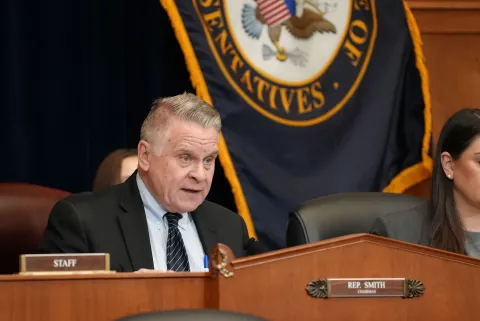
WASHINGTON, D.C. – Today, House Foreign Affairs Africa Subcommittee Chairman Chris Smith delivered opening remarks at a subcommittee hearing titled "Advancing Peace in DRC and Rwanda through President Trump’s Washington Accords".
-Remarks as prepared-
My engagement in supporting peace between Rwanda and DRC spans more than three decades, from a focus on the immediate aftermath of the 1994 Rwandan Genocide to the current "Washington Accords for Peace and Prosperity." This skillfully and brilliantly brokered peace deal signified a new era in the region, one where peace through strength is brought to bear to end the lengthy, bloody, and costly conflict.
Bringing both parties to negotiate at the same table was historic in itself – the first time in modern history where such progress has been made on this conflict. The deals agreed to will secure extraordinary benefits for the DRC, Rwanda, and the United States.
Ensuring that all sides follow through on the commitments made at the signing in December is not only in the U.S. national interest but for the millions of people who suffer in the war, for future generations of Congolese and Rwandan children, and for the memory of the six million dead from this decades long conflict – a human toll that is both staggering and intolerable.
Over the course of the last serval years, I have chaired eleven hearings that have focused exclusively on the political crisis and violence in the DRC and/or Rwanda. Regrettably, each hearing has revealed that the international and US response has been half-hearted and indifferent especially in the face of such violence, tragedy and suffering.
Today, things are changing and under President Trump and his cabinet’s leadership the response is strong, sustained, and durable. I believe that signing the Washington Accords brings gravity to the commitments the leaders of DRC and Rwanda committed to, and this hearing today is as much a message about the seriousness this committee ascribes to those commitments.
In December of last year, I said that “I look forward to working on and watching the peace process unfold and ensure that the leaders of DRC and Rwanda are honoring the terms of the agreement." This is why I have called this hearing today, because there continue to be spoilers to the peace process, belligerents who act to undermine and embarrass the United States. Our goal today is to ensure that all parties – and all people – understand the benefits of the Washington Accords and that the governments of Rwanda and DRC are clear on the steps that can – and must – be taken to get there.
The incentives are spelled out clearly in the Regional Economic Integration Framework, mandating that DRC and Rwanda develop a structured roadmap for economic integration—covering mineral supply chains, infrastructure, energy, tourism, and other sectors—to underpin peace with shared prosperity and to attract investment.
Whereas, the Strategic Partnership Agreement –between the United States and each of the African governments (DRC, and separately Rwanda)—builds on the Regional Economic Integration Framework into a wider trilateral framework that links economic reforms, critical minerals governance, and security cooperation to U.S. strategic interests and investment commitments. This includes addressing child and forced labor issues in the mining industry through “full supply chain transparency, due diligence, and traceability; and adherence to internationally recognized standards to ensure responsible mining and sourcing.”
Very critical is that the Washington Accords include a four-phase “concept of operations” that both parties agreed to and that is essential for Rwanda agreeing to pull its troops back, but only if the DRC follows a synchronized schedule to eliminate the FDLR militia.
At a hearing of this subcommittee on May 5th of 1998 I noted that “the RPF-led Rwandan government has used the guilt of the international community as a shield to prevent criticism of its actions [in the DRC]... and the sheltering of Hutu participants in the genocide has led to continuing problems in that country."
Decades later the root causes of the conflict continue to boil over, the presence of FDLR and its genocidal ideology rightfully continues to be the Government of Rwanda’s primary national security concern in eastern Congo. But today we have good reason to believe that known areas of FDLR combatants are under M23 and Rwandan control, and I would expect to hear of developments that describe the measures being taken by M23 and Rwanda to demobilize those actors.
It is insufficient to say that M23 is an independent group or not party to the Washington Accords when there is a clear pattern of coordination driven by Kigali and the group. The Congolese army too has issues with the FDLR, including that there is no clear-cut policy that relocates and disarms individuals who should be viewed as a threat to the Congolese commitments.
In 2008 when I visited Goma, I said, “"If the new leaders cannot deliver the benefits of democracy—namely citizen protection and respect for human rights—the country could easily fall back into devastating wars." Clearly there are those who benefit from continued conflict, which is why I have been very supportive of the punitive measures Secretary Rubio took against specific Hong Kong and mainland China-based companies accused of financing armed groups, including M23.
These sanctioned groups include Congo-Dongyang Mining Corporation, which is a facilitator accused of sourcing minerals from conflict zones and moving them through Rwandan supply chains to Chinese refineries.
In 2023 I chaired a hearing and said, “from cobalt to cars, the entire supply chain is built on violence... We must break our dependence on minerals that finance the Chinese Communist Party and stop indirectly supporting the CCP's efforts to fuel instability."
The Washington Accords are more than minerals, it is a culminating event designed to end suffering and war, and as I asked in December 2012, "Can the inter-ethnic problems in the DRC and its neighbors be finally resolved so that a lasting peace... can be achieved? It is time now to find a way to bring an end to the suffering,” I say again, this is the time to focus on the benefits of peace.
###